


World Snake Day: New eDNA Test Detects Endangered Grey Snake
-
World Snake Day - 16 July
-
The grey snake (Hemiaspis damelii) is a highly elusive species, classified as an Endangered species under the EPBC Act.
-
Collaboration between environmental consultancy Umwelt Australia and EnviroDNA developed an eDNA assay that detected grey snake DNA in a water sample.
Australia is home to many impressive snake species. However, due to habitat loss and fragmentation, numerous species have become endangered. In honour of World Snake Day on 16 July, we are highlighting an innovative project collaboration between environmental consultancy Umwelt Australia and EnviroDNA that has produced a new tool for detecting one of eastern Australia’s most elusive endangered snakes.
The grey snake (Hemiaspis damelii) is hard to find. Listed as Endangered under the EPBC Act in 2022, it’s nocturnal, well-camouflaged, lives in fragmented floodplain habitats from central Queensland down through inland New South Wales, and is only active in specific environmental conditions, so that targeted spotlight surveys often come up empty. For consultants and regulators, confirming its presence — or absence — at a site is expensive and uncertain.
EnviroDNA and Umwelt have now developed and field-tested an environmental DNA (eDNA) assay that can detect grey snake DNA from a water sample. Because grey snakes hunt frogs around floodplain pools and wetlands, water is a logical place to look for the traces of DNA they leave behind — even though the species itself isn’t aquatic.
Working with reference tissue from the Queensland Museum, Australian Museum, and from non-invasive samples collected in the wild by the Umwelt team, EnviroDNA designed a test specific to the grey snake — checked against a close relative, the marsh snake (H. signata) and another threatened species that shares its habitat, the Dunmall’s snake (Furina dunmalli).
Between November 2025 and January 2026, Umwelt field teams collected 82 water samples from 41 sites across Queensland (Rockhampton, Western Downs) and New South Wales (Yarrie/Narrabri). The standout result came from a site in the Western Downs where a grey snake was visually observed in the water where samples were taken — and the lab subsequently detected its DNA from that sample. Two additional sites returned detections where snakes had not been observed but are known to occur.
The detection rate was modest, in line with expectations for a cryptic, low-density terrestrial species. Improvements to water filtering for turbid environments are likely to lift detectability in future surveys.
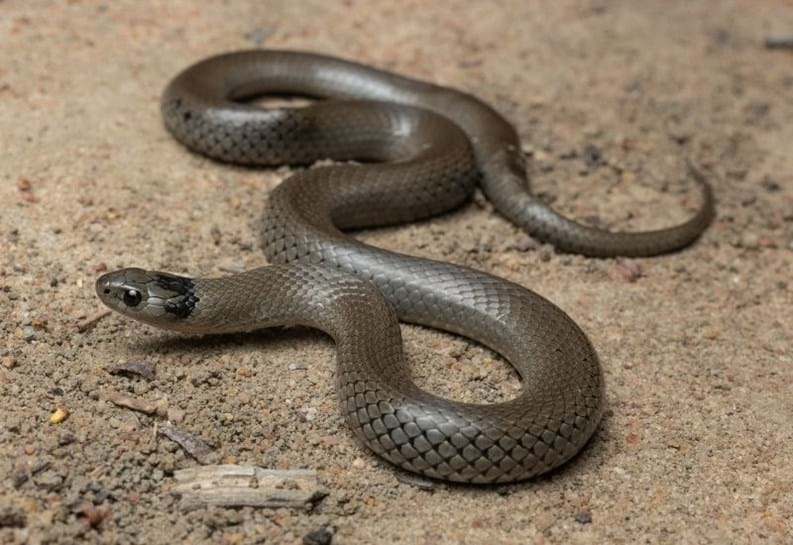
Grey snake, Credit: Donald McCallum
Learn more
- Project partners: EnviroDNA (Melbourne, VIC) and Umwelt (NSW/QLD). Reference tissue provided by Queensland Museum. The Australian Government provided the funding for this research project as part of the Department of Climate Change, Energy, the Environment and Water (DCCEEW) Renewables Environmental Research Initiative.
- Species: Grey snake (Hemiaspis damelii). Listed Endangered under the EPBC Act (Oct 2022); also Endangered under Queensland’s Nature Conservation Act 1992 (Nov 2001); Endangered in New South Wales under the Biodiversity Conservation Act 2016 (April 2024) and Endangered the IUCN Red List (2017).
- Method: Species-specific qPCR assay applied to water samples collected with EnviroDNA’s syringe-filter sampling kits.
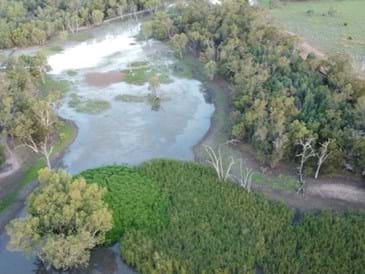

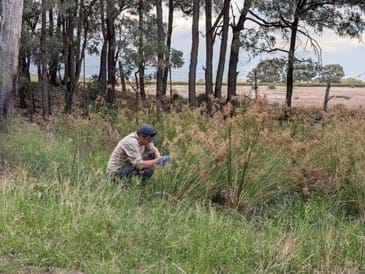
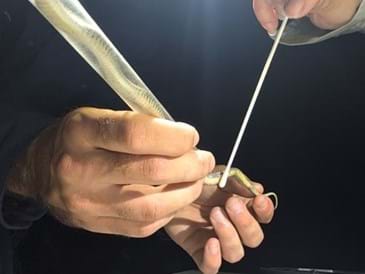
Photos from the field featuring the grey snake being swabbed for DNA, with Umwelt Australia.