


Burnett Mary Regional Group
Threatened Species Matrix & Detection
Natural resource manager
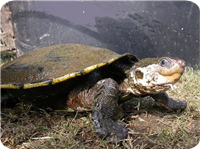
The Burnett Mary Regional Group (BMRG) in Queensland partnered with EnviroDNA to understand the distribution of freshwater turtles, focusing on the White-throated Snapping Turtle (Elseya albagula) and the Mary River Turtle (Elusor macrurus). Both species are listed on the EPBC list and are known to be difficult to detect in the wild using traditional survey techniques, because of their behaviours and low detection probabilities. eDNA provides a more sensitive, non-invasive way to confirm presence.
EnviroDNA designed an eDNA approach to enhance monitoring of these species throughout the region. This project applies evaluation processes from the Threatened Species Matrix to increase the likelihood of successfully detecting a species using eDNA. This approach identified knowledge gaps and provided BMRG with the most effective strategies for monitoring.
The Threatened Species Detection Matrix, evaluates four key areas to generate an overall confidence score for detecting a species:
-
Genetic resources – We evaluated the availability of public DNA sequences that uniquely identify the target species at specific gene regions.
-
Congeners – We assessed closely related species within the same genus whose habitats overlap. For the White-throated Snapping Turtle, the only co-occurring congener is the Northern Snapping Turtle (Elseya dentata).
-
Assay performance – We examined barcode sequences to determine the most appropriate metabarcoding assays and evaluate their ability to differentiate between closely related species.
-
Past detections – We reviewed historical detection data to gauge real-world assay performance. Using the Vertebrate 12S assay, the White-throated Snapping Turtle has been detected over 100 times, providing strong confidence in the method.
The Result = Confidence score – Matrix provides overall score using a traffic light (red, green, and yellow) system to indicate confidence at every step.
Our evaluation found strong genetic resources for the White-throated Snapping Turtle, clear separation from the Northern Snapping Turtle, robust assay performance, and extensive past detection records—resulting in a high confidence score for BMRG.
Results
EnviroDNA developed and validated targeted qPCR assays using reference samples and public genetic data for the White-throated Snapping Turtle. Water samples collected across the region were analysed using both a Vertebrate 12S metabarcoding assay and the targeted qPCR assay to confirm detections.
Both methods proved effective. The White-throated Snapping Turtle was detected in all expected sub-catchments—and a new population was discovered in Baffle Creek, providing valuable new insight for conservation and management.