


Umwelt Australia, on behalf of the Australian Government Department of Climate Change, Energy, the Environment and Water
qPCR Assay Development / Target Survey
Conservation
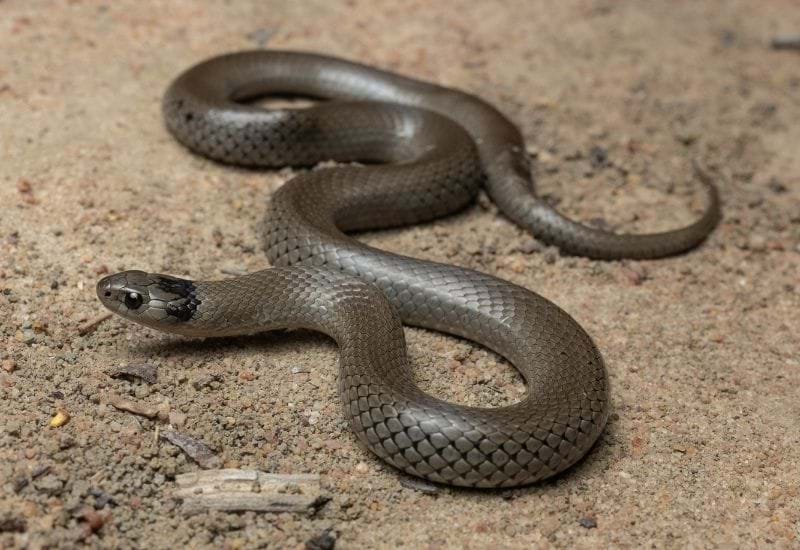
Credit: Donald McCallum
The grey snake (Hemiaspis damelii) is an Endangered species listed under the EPBC Act that presents significant challenges for traditional survey methods. The species is nocturnal, cryptic, and often occurs at low abundance within fragmented habitats. Conventional detection methods rely on labour-intensive spotlighting surveys.
For environmental consultants and conservation practitioners, reliably confirming the presence of grey snakes can therefore be both time-consuming and uncertain. To explore a more scalable and sensitive monitoring approach, Umwelt identified an innovative solution exploring environmental DNA (eDNA). The challenge was to design a targeted eDNA assay capable of detecting grey snake DNA from water samples collected in the field.
We partnered with Umwelt to design a sensitive qPCR assay. Working closely with the team, we obtained a range of tissue samples from to perform validation testing of multiple off-target reptile species, including Furina dunmalli and Hemiaspis signata. We conducted this validation to confirm that the assay can reliably discriminate grey snake DNA from field-collected water samples. This is a particularly important component given its low DNA shedding rate and apparent low population density.
Using user-friendly water sampling kits, we enabled Umwelt to collect consistent, high-quality samples without requiring extensive ecological training. Between November 2025 and January 2026, 82 water samples from 41 sites were collected by Umwelt personnel for laboratory analysis. The sites were spread across three regions in the known range of the grey snake: central Queensland, southern Queensland and northern New South Wales.
All samples were analysed using species-specific qPCR assays performed in triplicate, with comprehensive negative controls incorporated throughout the laboratory workflow to ensure result integrity and confidence in detection outcomes. During this partnership, EnviroDNA worked collaboratively with Umwelt and provided hands-on guidance, to help integrate eDNA into their surveys.
Results
The grey snake assay successfully detected grey snake DNA in environmental water samples, demonstrating the potential application of eDNA methods for detecting this cryptic species in field settings. Overall, the project demonstrates the feasibility of integrating targeted assay development with operational field sampling for rare reptile detection. It also provides a foundation for future optimisation and broader application of eDNA-based monitoring approaches for threatened species.
Impact
- Environmental managers can access improved applications for grey snake detection reliability and sensitivity
- The speed, cost-effectiveness, and scalability of implementing target species qPCR screening, means data can be quickly accessed to enable earlier management decisions and better outcomes for the species
- Higher-quality species data supports strengthened management outcomes


Photos from the field featuring the grey snake being swabbed for DNA, with Umwelt Australia.
More information
- Project partners: EnviroDNA (Melbourne, VIC) and Umwelt (NSW/QLD). Reference tissue provided by Queensland Museum. The Australian Government provided the funding for this research project as part of the Department of Climate Change, Energy, the Environment and Water (DCCEEW) Renewables Environmental Research Initiative.
- Species: Grey snake (Hemiaspis damelii). Listed Endangered under the EPBC Act (Oct 2022); also Endangered under Queensland’s Nature Conservation Act 1992 (Nov 2001); Endangered in New South Wales under the Biodiversity Conservation Act 2016 (April 2024) and Endangered the IUCN Red List (2017).
- Method: Species-specific qPCR assay applied to water samples collected with EnviroDNA’s syringe-filter sampling kits.