


Custom Assay Development: Detecting Australia’s Most Elusive and Threatened Species Using qPCR and eDNA
26 October 2026
-
Developing custom species-specific qPCR assays
-
Step-by-step overview to refining high specificity and sensitivity
-
How eDNA techniques can help Australia’s threatened species under the EPBC Act
Monitoring threatened species typically involves sightings, audio recordings, or field capture. However, these approaches depend on direct observation and are often ineffective for detecting species with low population densities, particularly those that are nocturnal, elusive, or aquatic, occur in isolation, or occupy large spatial ranges.
Australia has more than 1,700 species and ecological communities threatened under the EPBC Act. For many of these species, we know that absence from field surveys does not necessarily mean that the species is absent from the environment. That’s where environmental DNA (eDNA) and quantitative polymerase chain reaction (qPCR) come in.
By designing custom species-specific qPCR assays and analysing environmental samples, we provide a method that can detect species without the need for direct observation. And, to ensure reliable detection through qPCR and eDNA, we only design assays that are carefully developed, tested, and validated to ensure results are meaningful and trustworthy.
Our solution is cost-effective in comparison to observational techniques but can also be applied to complement traditional techniques and provide an additional layer of confidence. Here's a step-by-step overview of how we design assays with high-specificity and sensitivity:
-
1. Every assay begins with a sample.
A reliable qPCR assay starts an authentic reference sample from the target species. We work with clients to obtain a tissue sample or DNA sample from the species of interest, along with reference material from closely related species. This information provides us with a foundation for designing assays that distinguish the target species from other closely related species. Appropriate reference material also helps us understand how an assay performs and establish confidence in its ability to identify the species correctly.
-
2. Establish assay specificity
Custom species-specific assays must detect only the target species without incorrectly detecting closely related species. To ensure this, primers (short DNA sequences) used to target a specific genetic region are analysed against DNA from the target species and relevant non-target species. If a set produces an unintended response with a non-target species, we exclude it from progressing to validation. We do this to reduce the risk of false-positive detections so that only suitable primer sets progress through.
-
3. Define the limits of detection.
Knowing how reliably an assay can detect small amounts of DNA is equally critical. We establish thresholds that define when the assay is performing or underperforming. This is particularly important when working on threatened species assays because we are dealing with very low concentrations of DNA. Here are our two key performance measures:
- Limit of Detection (LoD): The lowest concentration of target DNA that the assay can detect with a defined level of reliability.
- Limit of Quantification (LoQ): The lowest concentration at which the amount of target DNA can be quantified with acceptable accuracy and precision.
-
4. From the lab to the field
Once an assay has been finalised in the laboratory, it’s now time to take it to the field. In the field we can test real-world environments to see whether it can perform under practical conditions. What we sample in this stage of testing depends on the species of interest. It could be water, sediment, soil, or other material. This field validation step is critical for understanding how it performs when there are other lines of potential interference, given the sample will likely include a broad range of information.
-
5. Provide clients with reliable assay reporting
We document every stage listed in the assay development process. This not only allows us to track and understand the strength and limitations of the final result but also provides our clients with an understanding of how thoroughly our assays are developed. We provide this level of transparency in our results to support confident management decisions.
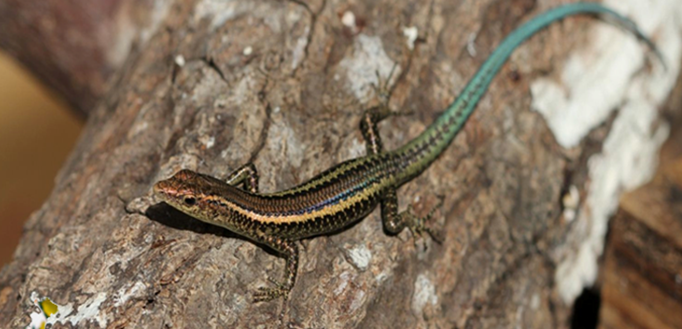
Image: Parks Australia. A custom species qPCR assay successfully detected the Christmas Island blue-tailed skink (Cryptoblepharus egeriae) in release sites
Learn more
Learn about qPCR applications for threatened species in our case studies:
- Understanding Predation and Diet of the Capricorn Yellow Chat
-
Building a Species-Specific qPCR eDNA Assay for Endangered Grey Snake
-
Critically endangered Christmas Island blue-tailed skink qPCR assay
Interested in learning more about qPCR applications for a particular species? Get in touch with our team to discuss how EnviroDNA can support your conservation objectives.